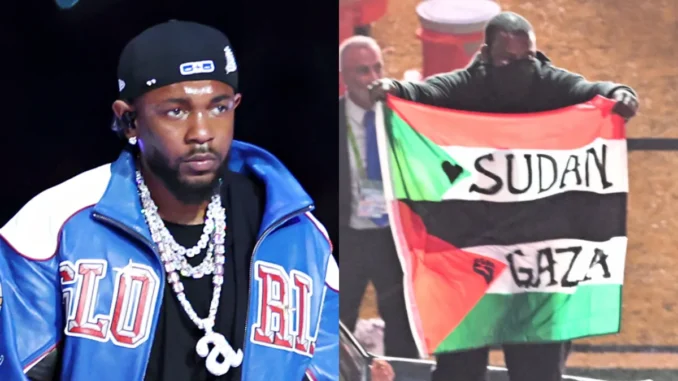
Halftime Uprising: Performer Arrested Months After Waving ‘Gaza-Sudan’ Flags During Kendrick Lamar’s Super Bowl Show
The NFL’s Super Bowl stage—renowned for its entertainment spectacle and global reach—took a political turn earlier this year when a background performer in Kendrick Lamar’s halftime show raised flags for Gaza and Sudan mid-performance. Months later, the controversy surrounding that moment has resurfaced, as Louisiana State Police have confirmed the arrest of 41-year-old Zul-Qarnain Kwame Nantambu, the performer responsible for the impromptu protest.
Nantambu was not a headliner, nor was he visible in the broadcast spotlight. But his message rang loud and clear to those in attendance and watching through alternate camera angles: political protest had made its way into one of the most tightly controlled media events in the world.
According to the Louisiana State Police, Nantambu surrendered voluntarily following coordination with his legal representation, after a warrant was obtained via the Orleans Parish Criminal District Court. He faces charges of disturbing the peace by interruption of a lawful assembly, stemming from his protest during the Halftime Show at the 2025 Super Bowl.
How It Happened: A Moment That Escaped the Script
Nantambu’s actions occurred during Kendrick Lamar’s performance of the song “TV Off.” As Lamar delivered his lyrics, Nantambu climbed onto a car prop in the background and raised flags representing Palestine and Sudan. The protest was not captured in the main television broadcast, but cell phone footage from fans and alternate broadcast angles showed the moment clearly.
He held the flags for several seconds before being confronted and physically removed by other individuals, including three men in suits who wrestled him to the ground. The incident unfolded swiftly, with security moving in within moments to stop the unsanctioned display.
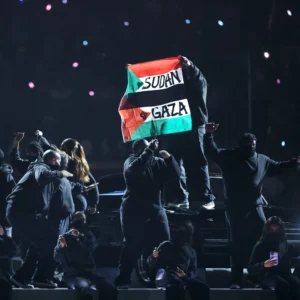
“Security and law enforcement personnel on site quickly recognized the unauthorized action and apprehended the performer after he refused to comply with their commands to stop,” said a statement from the Louisiana State Police.
NFL and Roc Nation React Swiftly
The NFL, which has long maintained strict control over Super Bowl performances and visuals, issued a strong response through its Vice President of Communications, Brian McCarthy.
“No one involved with the production was aware of the individual’s intent,” McCarthy said. “The individual will be banned for life from all NFL stadiums and events.”
The league’s official stance is consistent with its policy of maintaining an apolitical environment during broadcasts. In the past, the NFL has faced criticism for both its suppression of and tolerance toward political expressions on the field or stage. This situation, however, appears to have crossed a boundary set by the league and its partners.
Roc Nation, the company founded by Jay-Z and co-producer of the halftime event, also distanced itself from Nantambu’s protest. A spokesperson for the entertainment company said, “The protest was neither planned nor part of the production and was never in any rehearsal.”
From Background Performer to Symbol of Protest
Though not a mainstream figure, Nantambu has suddenly become a polarizing one. For some, he’s a background performer who broke protocol and disrupted the event. For others, he’s a bold protester using one of the biggest global platforms to spotlight humanitarian crises often ignored by major media outlets.
Nantambu has not released an official statement since his arrest, and neither his legal team nor Kendrick Lamar have commented publicly. Still, his protest is being discussed widely on social media, where debates around the morality, timing, and legality of the act rage on.
Supporters point to the crises in both Gaza and Sudan, calling his action a necessary wake-up call during a moment watched by hundreds of millions around the world. Critics argue that the Super Bowl Halftime Show is not the venue for political demonstrations and insist that performers should adhere strictly to contracts and rehearsal protocols.
Larger Implications for Super Bowl Performances
This incident underscores how even the most tightly choreographed entertainment productions can become a stage for unplanned political expression. The NFL and its partners will likely be revisiting their vetting processes, performer background checks, and security protocols to ensure no similar moments happen in future editions.
With the NFL already balancing a complex relationship with activism—ranging from Colin Kaepernick’s protests to widespread conversations around racial justice and social equity—this latest episode adds another layer to the ongoing debate about sports, entertainment, and politics.
In an era where silence is often interpreted as complicity, performers and athletes alike continue to navigate where, when, and how to make a statement. For Zul-Qarnain Kwame Nantambu, that decision has now led to legal consequences—but also to international attention.
As his court date approaches, one thing is clear: the conversation he sparked during those few seconds on stage is far from over.
Leave a Reply